

Blog
Thanksgiving Kitchen Fire Safety: How to Prevent Turkey Fryer and Grease Fires

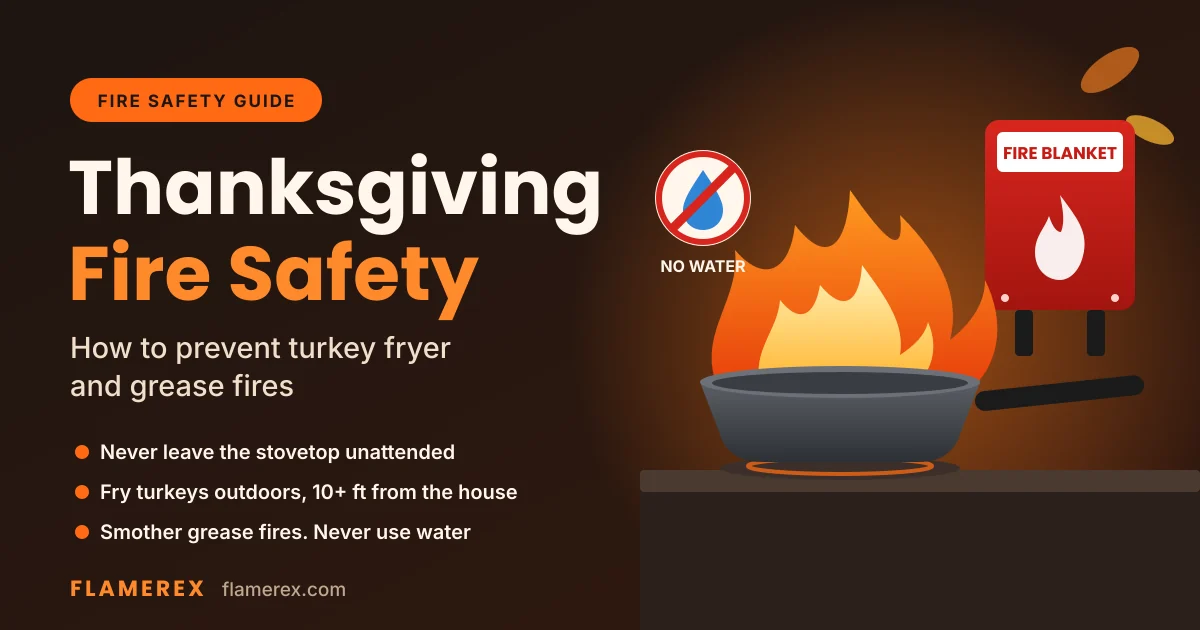
Quick answer: Thanksgiving is the single worst day of the year for home cooking fires in the U.S. The fixes are simple. Stay in the kitchen while anything is on the stovetop, fry turkeys outside and well away from the house, keep a lid or fire blanket within arm’s reach, and never pour water on a grease fire.

There’s a reason fire departments brace themselves every fourth Thursday in November. One cook is basting a turkey, someone else is reducing gravy, three side dishes are fighting for burner space, and the kids are running through the kitchen. It only takes one forgotten pan.
This guide covers what actually causes Thanksgiving fires, how to fry a turkey without setting the garage on fire, and exactly what to do in the first ten seconds if a pan goes up.
Key takeaways
- Never leave the stovetop unattended. Unattended cooking is the leading cause of home cooking fires, according to the NFPA.
- Fry turkeys outdoors only, on flat ground, never in a garage, on a porch or on a wooden deck.
- Thaw and dry the turkey completely. Ice and water hitting hot oil is what causes boil-overs.
- Smother, don’t soak. Cover a grease fire with a lid or fire blanket and turn off the heat. Water makes it explode.
- Test your smoke alarms this week, before the guests arrive.
Why are kitchen fires so common on Thanksgiving?
Thanksgiving has more home cooking fires than any other day of the year. The National Fire Protection Association (NFPA) estimates that 1,446 home cooking fires were reported to U.S. fire departments on Thanksgiving Day 2023, more than three times the daily average. Christmas Day and Christmas Eve came second and third.
The pattern is easy to explain once you picture a real Thanksgiving kitchen:
- Too many things cooking at once. The oven is full, all four burners are busy, and attention is split.
- Distractions. Guests arrive, the game is on, someone needs a hand with the table.
- Crowded counters. Paper towels, oven mitts, recipe printouts and dish towels end up next to hot burners.
- Long cooking times. A turkey roasts for hours, which makes it easy to forget what’s on the stovetop.
According to the NFPA’s analysis of 2019–2023 data, cooking caused 80% of home fires on Thanksgiving Day. Ranges and cooktops are behind nearly three in five cooking fires, far more than ovens. In other words, the danger is mostly on top of the stove, not inside it.
How do you fry a turkey safely?
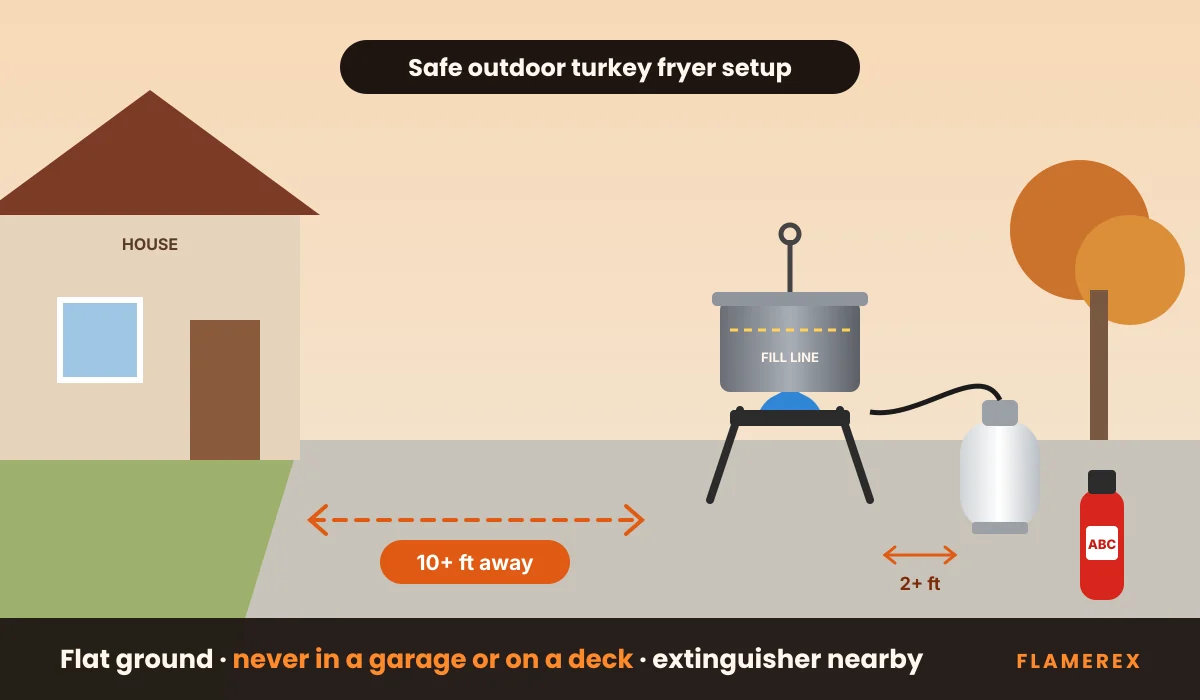
The safest way to fry a turkey is outdoors, on flat ground, at least 10 feet from your house, with the turkey fully thawed and dried, and with someone watching the fryer the entire time. The NFPA actually discourages oil-filled turkey fryers altogether and suggests buying a fried turkey or using an oil-free fryer instead.
If you’re frying anyway, follow these steps:
- Measure your oil the day before. Put the turkey in the empty pot, cover it with water, then take the turkey out and mark the water line. That’s your oil fill line. Dump the water and dry the pot completely. The U.S. Consumer Product Safety Commission (CPSC) recommends this method to prevent overfilling.
- Set up outside, away from everything. Use a flat driveway or patio, well clear of the house, garage, fences and trees. Never in a garage, on a covered porch or on a wooden deck.
- Keep the propane tank separate. The CPSC advises at least 2 feet between the propane tank and the burner.
- Thaw and dry the turkey completely. A frozen or wet turkey makes hot oil bubble over the rim, and that oil hits the flame below.
- Heat the oil with eyes on it. The CPSC notes that most reported fryer incidents happen while the oil is heating, before the turkey even goes in. If the oil starts smoking, turn off the gas.
- Lower the turkey slowly with the burner off. Turn off the flame, lower the bird gradually, then relight once it’s settled.
- Never leave it. Not for a minute. Keep kids and pets at least 3 feet away.
- Have a fire extinguisher nearby and protective gear on: long oven mitts, closed shoes, safety glasses.
If a fryer catches fire, step away and call 911. Do not try to fight a fryer fire with water, and don’t try to move the pot.
What should you do if a grease fire starts on the stove?
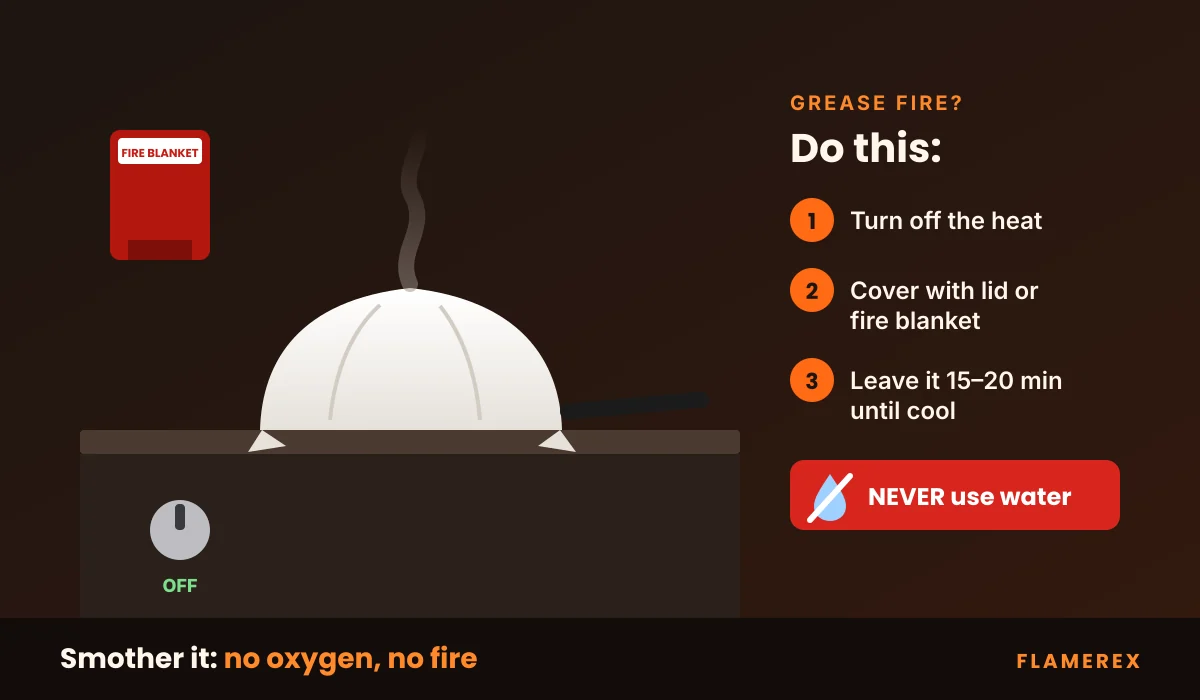
If a grease fire starts, turn off the burner, cover the pan with a lid or a fire blanket, and leave it covered until it cools completely. Never throw water on it. Water sinks under the burning oil, flashes into steam, and throws flaming grease across the kitchen.
Here’s what to do, in order:
- Turn off the heat if you can reach the knob safely.
- Cover the flames. Slide a metal lid or a cookie sheet over the pan, or pull your fire blanket from its pouch and lay it gently over the pan. (Not sure how? Here’s our step-by-step guide on how to use a fire blanket.)
- Leave it alone for at least 15–20 minutes. Lifting the cover early lets oxygen back in, and hot oil can reignite.
- For a tiny flare-up only, baking soda or salt can smother the flames. Never use flour, which can ignite.
- If the fire spreads beyond the pan, get everyone out, close the door behind you, and call 911 from outside.
Lid, fire blanket or extinguisher: what works best on a grease fire?
Each tool has its place, and the best kitchens keep at least two of them.
| Tool | Best for | Pros | Watch out for |
|---|---|---|---|
| Pan lid / cookie sheet | Small pan fires | Always in the kitchen, free | You need one that fits the pan |
| Fire blanket | Pan, grease and clothing fires | No mess, no training, works in seconds | One-time use; replace after a fire |
| ABC fire extinguisher | Larger fires, spreading flames | Fight from 6–10 feet away | Leaves powder everywhere; needs the PASS method |
| Baking soda / salt | Very small flare-ups | Quick and easy | Takes a lot; useless on bigger fires |
| Water | Never on grease | — | Causes an explosive flare-up |
| Flour | Never | — | Can ignite and make it worse |
For a deeper comparison, read our guide on fire blanket vs fire extinguisher.
How do you keep kids and guests safe in a busy kitchen?
The simplest rule is a 3-foot kid-free zone around the stove and oven. Mark it with tape on the floor if you have young children; it works better than repeating “get out of the kitchen” all afternoon.
A few more habits that help:
- Turn pot handles inward so nobody bumps them.
- Give one person the stovetop. When everyone “helps”, nobody’s watching the pan.
- Use timers for everything, not just the turkey. Your phone can run several at once.
- Clear the area around burners. Move towels, paper, packaging and oven mitts away.
- Watch loose sleeves. Roll them up or wear something fitted while cooking.
- Keep candles away from the kitchen and off crowded tables.
- Check your smoke alarms. Press the test button on each one before Thanksgiving week. Install a working smoke alarm on every level of the house.
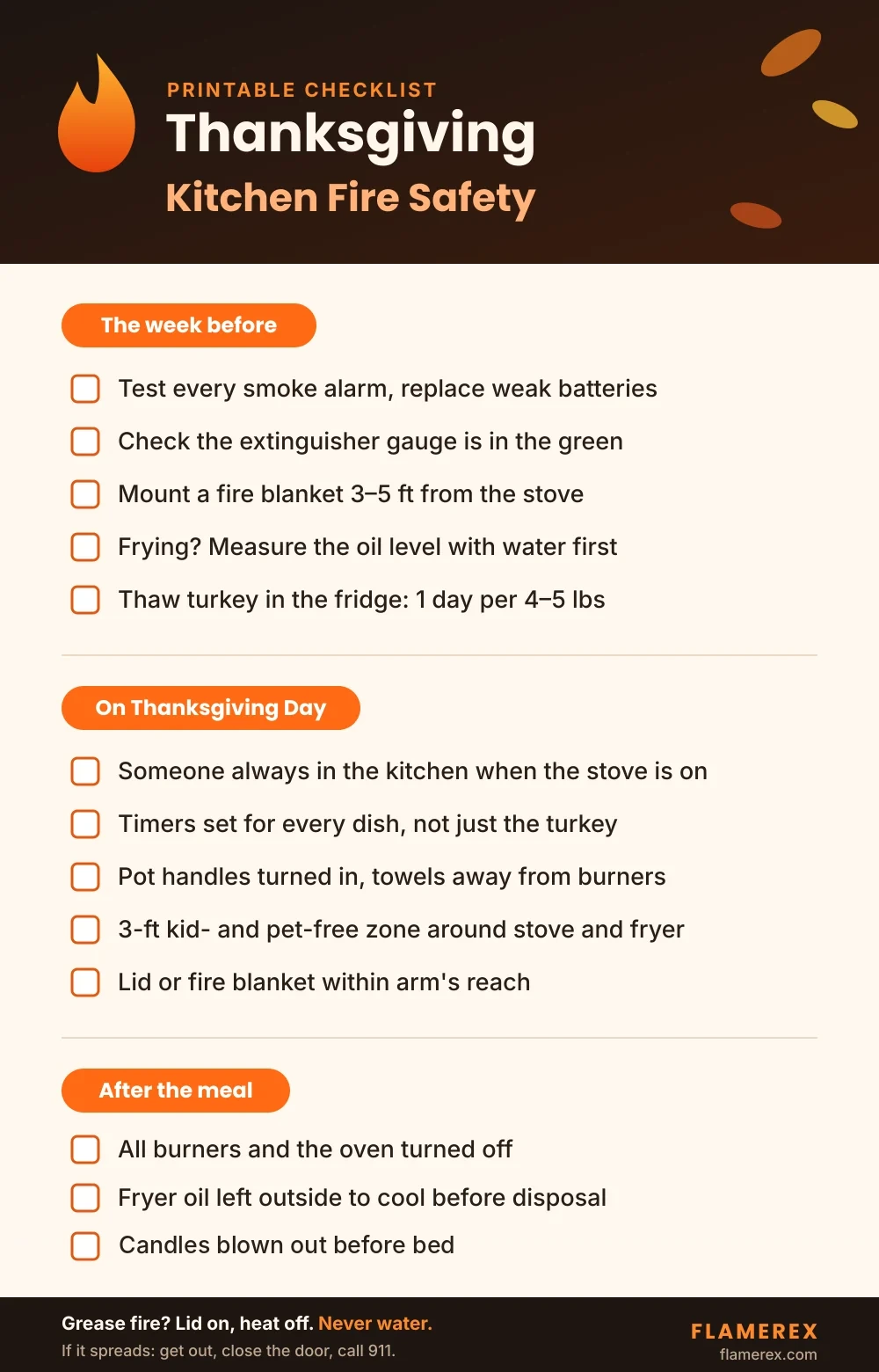
Your Thanksgiving kitchen fire safety checklist
Screenshot this list or download the printable version.
The week before
- Test every smoke alarm and replace weak batteries
- Check your fire extinguisher’s pressure gauge is in the green
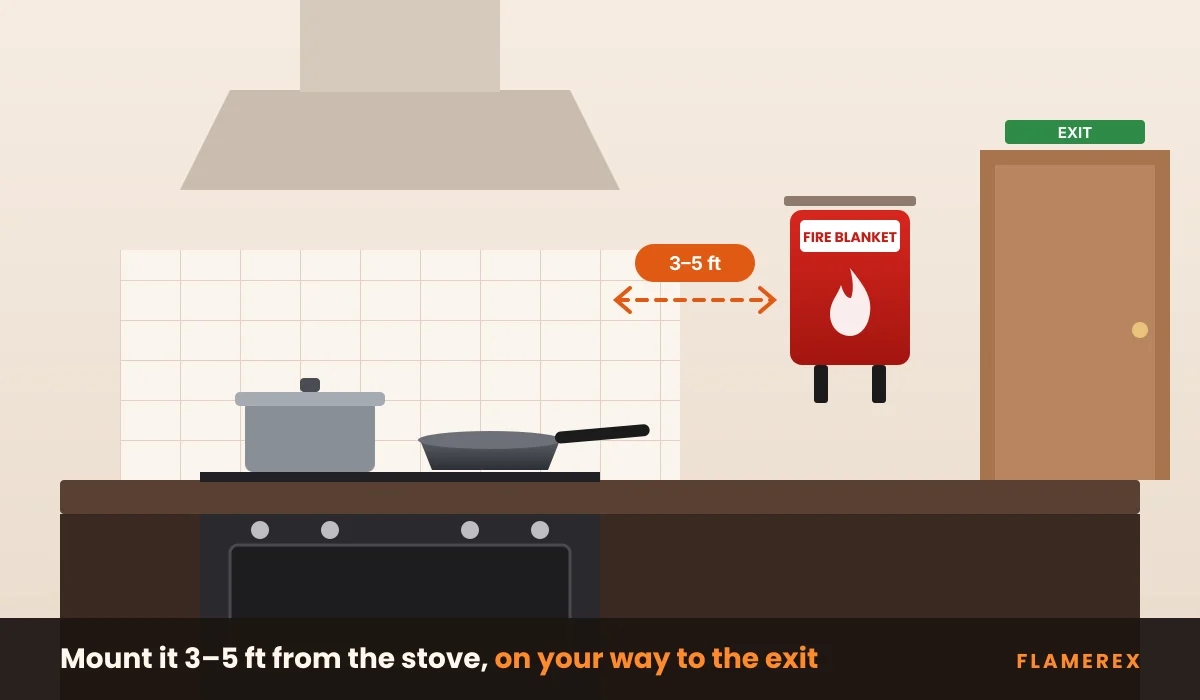
- Mount a fire blanket near the stove, 3–5 feet away, by the exit
- If frying: test the oil level with water and pick your outdoor spot
- Start thawing the turkey in the fridge (allow about 24 hours per 4–5 lbs)
On Thanksgiving Day
- Someone is always in the kitchen when the stovetop is on
- Timers set for every dish
- Pot handles turned in, counters around burners cleared
- 3-foot kid- and pet-free zone around the stove and fryer
- Lid or fire blanket within arm’s reach of the stove
After the meal
- All burners and the oven off
- Fryer oil left outside to cool completely before disposal
- Candles blown out before bed
What fire safety gear should you have ready for Thanksgiving?
You don’t need a lot. Two things cover most kitchen emergencies:
- A fire blanket by the stove. The Flamerex Fire Blanket 2-Pack is made for exactly this: a 47″ × 47″ fiberglass blanket rated to 1500°F that pulls out of its wall pouch in one motion. Hang one 3–5 feet from the stove near your kitchen exit. Keep the second one with the grill or outdoor fryer gear.
- A fire extinguisher by the kitchen exit. A 2.5 lb ABC fire extinguisher handles a fire that has grown past a single pan. Mount it where you’d grab it on your way out, not right next to the stove.
If you’re shopping for a blanket and want to compare options, see our best fire blanket for kitchen buyer’s guide.
Frequently asked questions
Can you put out a turkey fryer fire with water?
No. Water on a burning turkey fryer is extremely dangerous. The water sinks below the hot oil, turns to steam instantly, and blasts burning oil outward, which can spread the fire and cause severe burns. Turn off the gas if you can do it safely, move everyone away, and call 911.
How far should a turkey fryer be from the house?
Keep a turkey fryer at least 10 feet from your house and any other structure, including garages, fences, decks and trees. Set it up on flat, level, non-flammable ground such as a concrete driveway. Never use a fryer inside a garage or under a covered porch, even if it’s raining.
Can a fire blanket put out a turkey fryer fire?
A fire blanket can smother a small flare-up at the rim of a fryer if you can reach it safely and turn off the gas first. Once a fryer is fully engulfed or oil has spilled onto the ground, a blanket won’t be enough. Get away from the fryer and call 911.
Is it safe to leave the oven on while the turkey roasts?
You can leave the kitchen briefly while a turkey roasts in the oven, but stay home and check on it regularly. Use a timer as a reminder. The stovetop is the bigger risk: never walk away from a pan on a lit burner, especially one with oil in it.
What should you do after a grease fire is out?
Leave the cover on until the pan is completely cool, at least 15–20 minutes. Ventilate the kitchen. Check that the stove and nearby surfaces aren’t damaged before using them again. If you used a fire blanket, throw it away and replace it, since a blanket exposed to fire or grease shouldn’t be reused. If anyone was burned or smoke spread through the house, get medical advice and call the fire department to check.
Sources
- National Fire Protection Association (NFPA), Thanksgiving home cooking fire data, released November 2025
- U.S. Consumer Product Safety Commission, Safety Tips for Turkey Fryers
- Illinois Office of the State Fire Marshal, 2025 Thanksgiving cooking safety release (summarizes NFPA’s 2019–2023 figures)
2 thoughts on “Thanksgiving Kitchen Fire Safety: How to Prevent Turkey Fryer and Grease Fires”